



Meet
Autocapture


June 17, 2026
Scribe’s updated brand isn’t just a new look — it's where we’re headed
By Jennifer Smith, CEO
We just unveiled a new brand for Scribe. Most people (rightfully so) don’t pay attention to brand refreshes. And I’m not the kind of CEO who obsesses over the nuance of colors and design patterns.
So, why did we change it…and why am I writing about it? Because our new brand visualizes how we believe work changes for all of us — and it’s a sneak peek into what we’re building to make that vision a reality. (More on that in a minute. But if you can’t wait, sign up for early access here →)
And if you are design-obsessed, or if you’ve just always wondered what goes into building a brand, Aliza Edelstein, VP of Product Marketing & Brand, gives a great behind-the-scenes look.
The next big shift will fix what’s always been broken
Every major shift in tech has one thing in common: it started with turning something informal into structured information.
Customer relationships existed long before CRM software. Financial operations existed long before ERP systems. Source code existed long before version control. The breakthrough came from creating a system of record for something businesses already depended on, but could not fully see. And they were transformative because once information is structured, it becomes computable. It can be analyzed, shared, improved, and eventually automated. Entire tech categories are built on this way of thinking.
Today, there’s still a massive category of enterprise knowledge that’s outside of computerized systems: how work actually gets done.
Think about it: every successful company exists because it has learned something about the world that others have not.
- An insurance company learns how to price risk
- A manufacturer learns how to consistently produce high-quality products at scale
- A retailer learns how to predict demand and move inventory efficiently
Over time, every business accumulates thousands or even millions of small decisions, workarounds, judgments, handoffs, and learned behaviors. That’s the context that runs the business.
People absorb traces of it by doing the work: making decisions, running through processes, and seeing how other people behave. It lives in conversations, habits, and people’s experience. It’s very individual. (This won’t surprise anyone who’s ever had to distill their workflow into something less precise but understandable for their manager.) It’s “embedded” in the organization, but isn’t something you can find in any set of documents.
This accumulated know-how is the MOST valuable asset a business owns. It’s the primary source material for a company’s competitive advantage. And yet, it’s the least visible part of any business; almost no organization can fully see or understand itself.
It’s wildly suboptimal that we run businesses this way. Up until now our alternative has been manually documenting everything. (I did that for almost a decade as a McKinsey consultant. It doesn’t scale.)
Many AI conversations focus on model capability: can this system write, reason, code, or perform a specific task at a human level? Those questions were important, because for a long time the models weren’t there yet.
That’s not true anymore. Now we face a much more practical constraint. AI models are powerful enough to transform organizations, but most companies can’t explain themselves clearly enough to AI for that to happen. It’s like every company hired a bunch of Nobel laureates and left them in the lobby without a badge to get upstairs.
The opportunity now is to get all three types of intelligence — your people, your institutional knowledge, and your AI — working together to drive value for your business. (“Everyone in the elevator!”)
Because if AI has access to your context, it can understand your institutional know-how at a scale no person or team could ever hold in their heads. It can see patterns and relationships across hundreds of thousands of workflows, handoffs, decisions, and exceptions. It can do something that wasn’t humanly possible before.
For the first time ever, a company could fully understand itself.
Context wouldn’t be trapped inside people's heads or buried across documents, systems, and conversations. It’d be scaled, collective know-how that’s accessible, dynamic, and useful to everyone.
We don’t really have a name for this yet. You could call it a self-aware org. The brain of a business. Or think of it as a digital twin of the entire company. Whatever the name, it’s how context will finally move as fast as the business needs it to. If markets shift or new tech arrives, businesses won’t scramble like they do now to catch up. Companies will be so adaptable that when we look back at our current pace of change, it’ll feel very slow – like dial-up internet slow.
The goal is clear. But the next question is: how do you bridge what people know with what AI (and your people) need?
That’s what we’re building at Scribe. We started with Capture and Optimize, and now have our next release coming very soon. If you want to be the first to see it, request early access here →
How our brand visualizes the future
Most knowledge work today is painfully consumed by coordination, context-sharing, and execution — work that’s necessary, but rarely the reason people chose their careers. Imagine a sales person: they (presumably) got into sales because they love to build customer relationships. Yet they usually spend most of their day NOT interacting with customers, but on coordination, data entry, reporting, and other work.
I believe AI will reshape our workday. We’ll spend more time operating in our agency: defining our goals and applying our carefully honed taste to our chosen craft. (And a lot less time managing the process.) This will make work feel much more fun and rewarding to each person. As more of our time is spent on higher-value contributions, our collective output will also increase. And this is really the most crucial part: all work will feel more meaningful, because it’ll be centered on what people are uniquely good at.
We’re already seeing signs of that. Our most talented team members are achieving levels of output that would have been difficult to even imagine just a few years ago. People are accomplishing more, moving much faster, and tackling increasingly complex problems. And it’s addictive, because work feels more rewarding when effort translates into meaningful progress at a much higher rate. Despite all the concerns about how AI could negatively impact knowledge workers, I’m seeing people become more energized and engaged in their work as they experience increasing returns to each marginal hour (maybe even minute) of their time.
So when it came to designing our new brand, it had to reflect the future we’re seeing. It had to feel uniquely and beautifully human. And it needed to represent this future of humans, working alongside AI, to achieve human objectives.
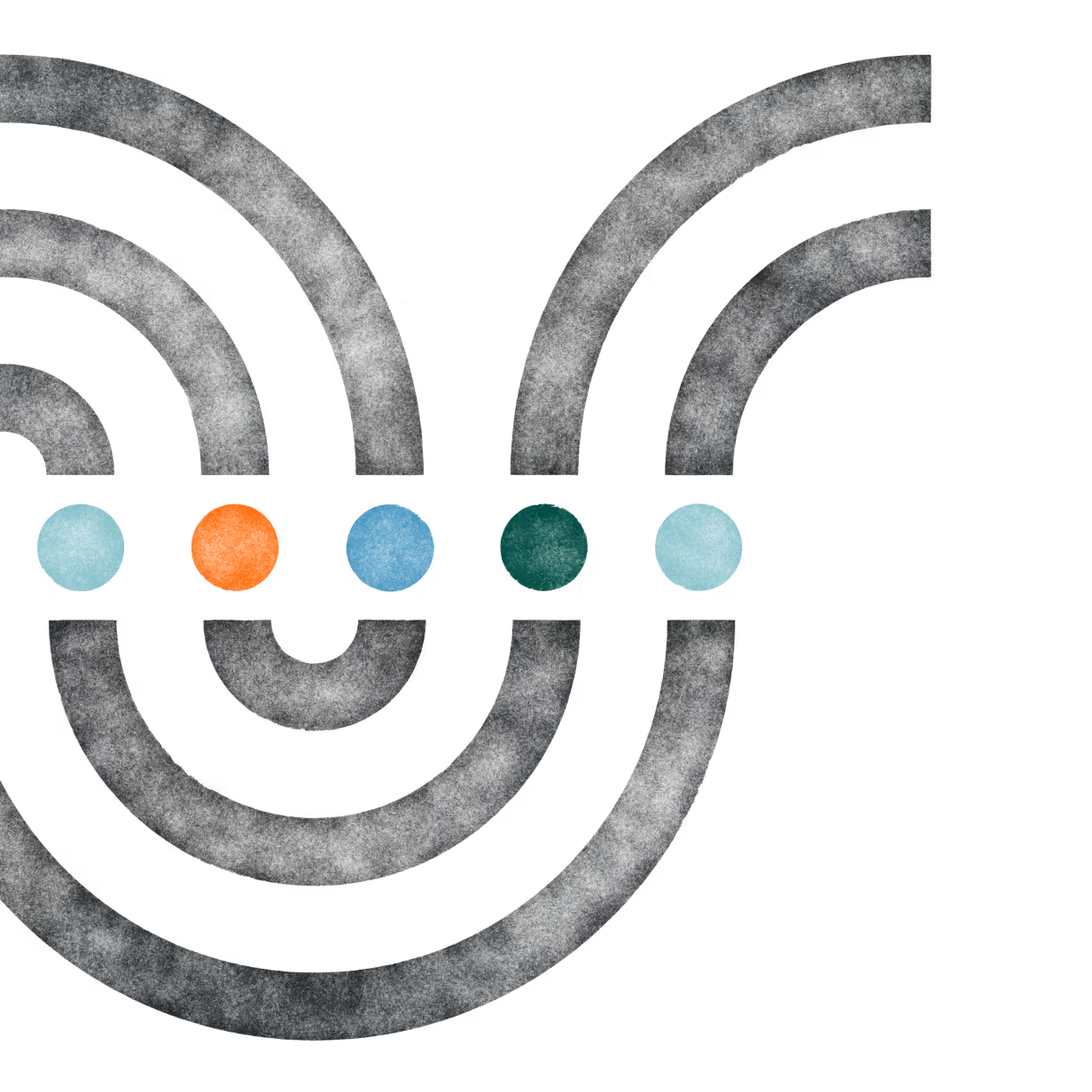
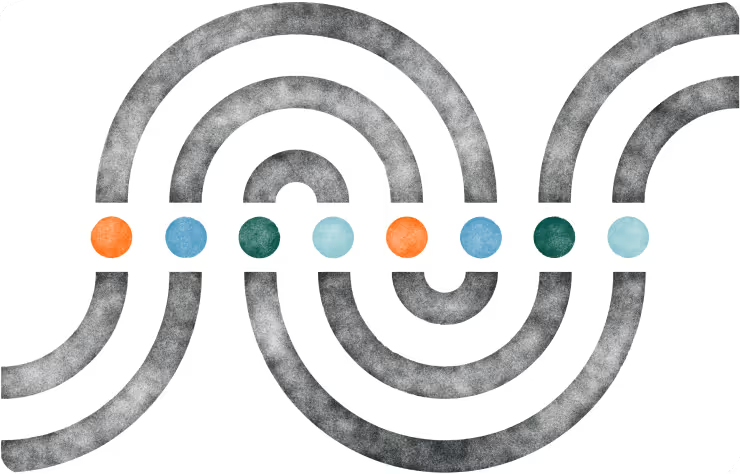
Throughout our new brand, you’ll see evidence of things made by human hands. All of the artwork, watercolors, and imagery is hand-painted, not generated by AI. We have over 1,600 hand-drawn dots in our new design system. The variations and differences are incredibly subtle. We wanted to show how what people create has nuance and texture you might not identify immediately as “human made,” but it is something you can feel. We pair those very human elements with precise grids and lines to signify the machine-efficient, highly optimized systems people will work alongside.
Together, the lines and dots visualize something we think about constantly: how work moves through an organization. Every dot is a node: a person, a moment, a piece of knowledge, an AI agent. On its own, it’s just potential. The lines are context moving, knowledge passing from one person to the next, workflows connecting across teams, information flowing to wherever it's needed.
Most organizations can see their inputs and their outputs, but not what happens in between. That’s about to change. Our new brand answers the question: what will it look like when an organization finally understands itself? Scribe has always been working to answer that through our products. Now we’ve also mapped it as a visual language too.
What’s next
We’re much closer than people realize to a major shift in how we work. Every business was built on human ingenuity, and will continue to be shaped by it. Making org know-how legible is how we get AI to actually start working alongside us. And from there AI can relentlessly optimize, and we will decide what’s worth our time.
Onwards,
Jennifer
P.S.
If you want more info about how we built our brand, head over here →
And if you love our new look, we dropped new merch. Go to Scribe Supply Co. →