



Meet
Autocapture



March 24, 2026
The Optimization Era: Transitioning to the Agentic Age with Howie Xu
In this article

Transformation you can finally see
The jump from a powerful tool to a fundamental shift in productivity isn't instantaneous. When electricity was first invented, it took nearly thirty years for the world to truly grasp its value… not because the technology wasn't ready, but because we hadn't yet learned how to work differently.
According to Howie Xu, Chief AI & Innovation Officer at Gen Digital, we are currently at a similar tipping point with AI. To survive and thrive in the coming "Agentic Era," leaders must move beyond asking AI questions and start treating it as a coordinated, virtual extension of their workforce.
Who is Howie?
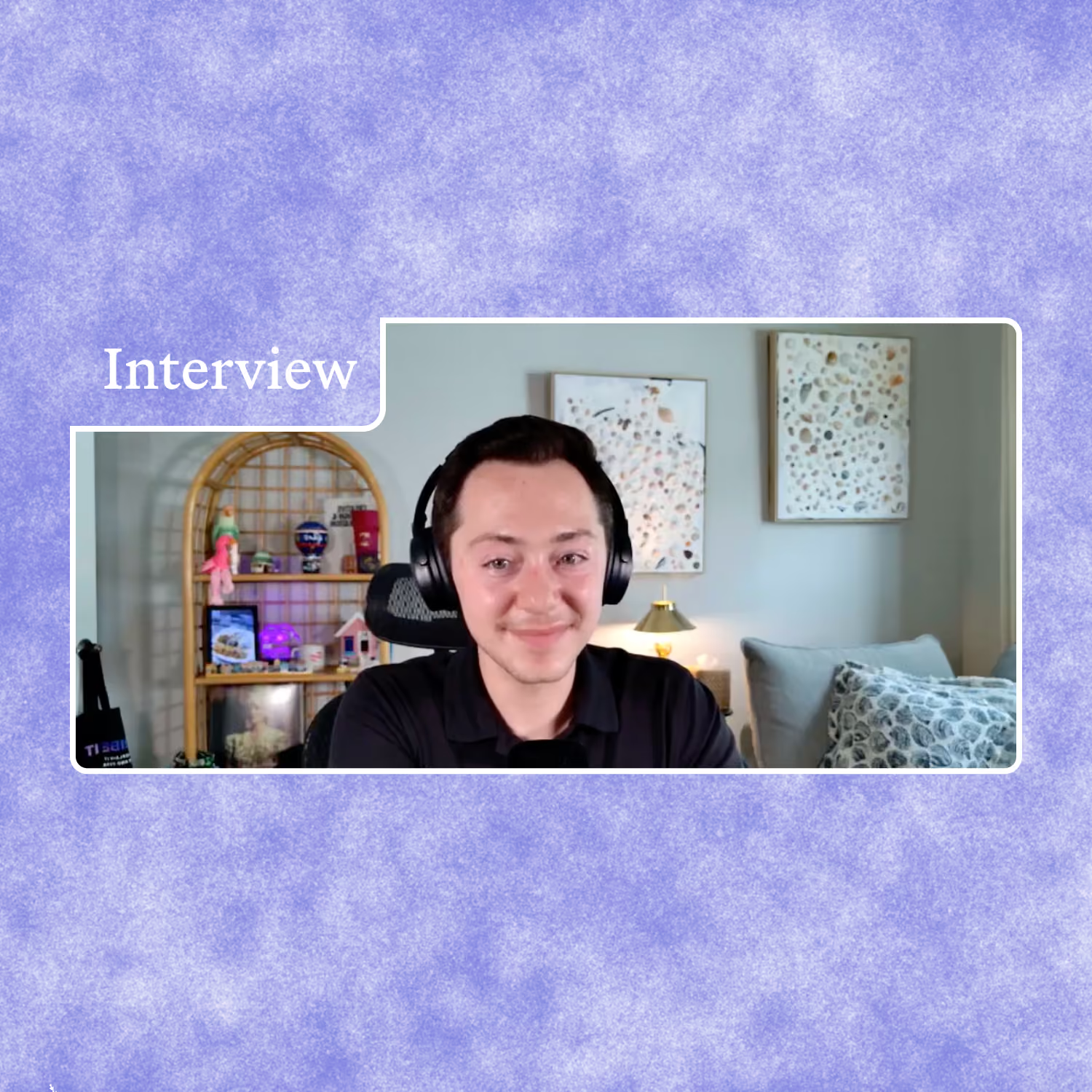
Howie Xu is the Chief AI and Innovation Officer at Gen Digital, the parent company behind household names like Norton, Avast, LifeLock, and Moneyline. With over 500 million users worldwide, Howie’s mission is to help consumers navigate their digital lives more safely and productively.
What Gen Digital does: Gen Digital provides consumer-facing cybersecurity and productivity products designed to protect users in an increasingly complex online world. Howie’s daily focus is on bringing these millions of users into the AI era by delivering native products that serve as "personal butlers" protecting data while proactively managing the digital noise.
Beyond the Better Google: The Shift from Answer to Action
For the last three years, the AI conversation has been dominated by Large Language Models (LLMs) that provide better answers than a traditional search engine. But Howie argues that getting an answer from a chatbot doesn't fundamentally change how we work. The next phase of the Optimization Era is defined by action: coordinated, autonomous agents that don't just talk, but execute.
To unlock this value, organizations must stop treating AI as a tool and start treating it as a virtual staff member. This requires a total rethink of team structure.
Howie envisions a world where a team of ten consists of three humans and seven virtual agents, all sharing the same organizational context to drive 2x or 3x productivity gains.
"Once you start thinking, 'I get up in the morning, what job do I give to my three virtual staff?'... then your life is different, your work life is different." – Howie Xu
The Assembly Language of Work: When Coding Becomes a Hobby
One of Howie's most provocative predictions is the total transformation of technical roles. A programmer by heart and training, he compares the current state of software engineering to the early days of computing.
"The coding we knew in the last ten years is equivalent of assembly language coding fifty years ago. Five years from now, programming as we knew it... will be taken over by AI almost completely." – Howie Xu
In Howie’s view, this doesn't mean the end of the software engineer; it means the end of manual syntax as the core of the job.
He predicts that "coding will be a hobby, a fun part of the job," while the real work shifts toward architectural decisions and design.
Just as we no longer write in assembly language and driving will eventually become a recreational activity rather than a commute necessity, AI will handle the "how" so humans can focus on the "why".
The Tipping Point: Moving from Conversation to Coordination
A significant hurdle to this agentic future is the tribal knowledge currently stuck in everyone’s head. AI agents are powerful, but they are suboptimal without the specific context of your organization’s structure, culture, and undocumented processes.
Howie points out that technology evolution is no longer the bottleneck; the bottleneck is our ability to feed that technology the context it needs to act.
For a coding agent to be effective, it needs more than just documentation, it needs the "invisible" knowledge of the team to be able to contribute like a normal team member. Until this problem is solved, and onboarding is inclusive of our virtual agentic co-workers, we won’t see these massive productivity improvements.
Harvesting Tribal Knowledge: Making the Invisible Visible
Extracting knowledge from a human head is notoriously difficult because you cannot simply ask an employee to spend an hour a day reflecting on what they know. To build an effective virtual workforce, organizations need a natural, passive way to capture these invisible workflows as they happen.
- Capture the Unmet Need: Most work is done on autopilot, meaning the most valuable process data is often the most invisible to the person doing it.
- Create a Knowledge Hand-off: For virtual staff to become visible and effective, there must be a seamless way to pass tribal knowledge from the human to the agent.
- Define Your New North Star: Howie suggests a new fundamental metric for the AI era: Tokens per employee per day. While not a perfect measure of value, it serves as a proxy for how deeply your team is actually interacting with and delegating to their virtual assistants.
Pro-tip: Tools like Scribe Optimize are designed to solve this exact pain point by mining workflow data and tribal knowledge in real-time. By turning invisible work into digital playbooks, you provide the context agents need to transition from chatbots to virtual employees. See how work happens, then how it can be done better with Optimize.
The Human Accountability Filter: Who Gets the Bonus?
As we move toward a world of invisible staff surrounding us, a major question of leadership arises: who is responsible for the result?
Howie believes that while AI assists in decision-making by providing data and analysis, it can never hold the ultimate responsibility.
"You can't point to the AI, 'hey, you are fired.' I need to be fired for making certain decisions not right... so who gets more bonus? That's human, not AI." – Howie Xu
This "Accountability Filter" is why human oversight remains the most critical component of any AI strategy. Humans are the ones who must grill the AI’s logic, sign off on the outcomes, and bear the professional consequences.
AI agents can do the legwork during the night and deliver a report by morning, but the human remains the one who translates those tokens into real-world accountability.
Future-Proofing the "Social Animal"
As the technology matures, Howie believes that the human connection will become our most guarded asset. While AI might take over programming or even driving, it will never replace the human desire for shared experiences.
We will still go to stadiums to watch human athletes and to offices to connect with human colleagues because our nature as social animals hasn't changed in millions of years.
The Optimization Era isn't about replacing the human; it’s about using technology to get back to what humans do best. To start your journey toward an agentic workforce, your Monday morning move is to change your perspective:
- Stop Searching, Start Delegating: Reframe AI from a search engine to a virtual employee with a specific job description; the more context you can give them, the better!
- Audit Your Tribal Knowledge: Identify the invisible processes that your virtual staff would need to know to be effective.
- Measure Engagement: Track how often your team is actually utilizing AI tokens to move their work forward.
When you treat AI as a team member rather than a tool, you don't just optimize your work, you redefine it.

Ready to try Scribe?


Copyright © 2026 Colony Labs, Inc. dba Scribe. All rights reserved.