



Meet
Autocapture



September 28, 2026
How we're actually designing with AI
Inside the shift from Figma-first to AI-first prototyping

Instantly capture and optimize workflows so your team works smarter and faster.
By Jing, Staff Product Designer at Scribe
Designing has shifted more in the past two months than it did in the two years before that. Last December, if you'd asked me how useful AI was in my process, I'd have said: good for some things, but I'm still mostly in Figma. Now I only open Figma to do final specs and measurements — if at all.
I wanted to talk to someone who'd been ahead of this curve, so I sat down with Derick, a fellow Staff Product Designer at Scribe, who's leading our OKR to validate designs earlier by leveraging AI prototyping tools.
Jing: When did designing with AI actually start to feel different for you?
Derick: Honestly, not that long ago. Two years ago I don't think you could really design with AI in any meaningful way. It's only recently that it started to feel like there were reliable, expected outcomes.
The clearest signal was last week. I presented in a product review and realized: that was the first time in 12 years of my career that I actually wasn't using the design tool to present. I used to walk through Figma frames or a Principle prototype — tools that could simulate the experience, but always felt slightly fake. This time I presented something built with AI, with real interactions and real data. That felt like a real shift.
Jing: What does “built with AI, with real interactions” look like in practice?
Derick: For a recent document import feature, I asked Magic Patterns (an AI prototyping tool) to build a drop zone — a real one. I can actually drag a real file in there and see how it feels from an interaction and animation standpoint. I made a revised version thirty seconds later. Before, I'd have mocked that up in Figma and asked everyone to imagine how it felt. Now I just feel it.
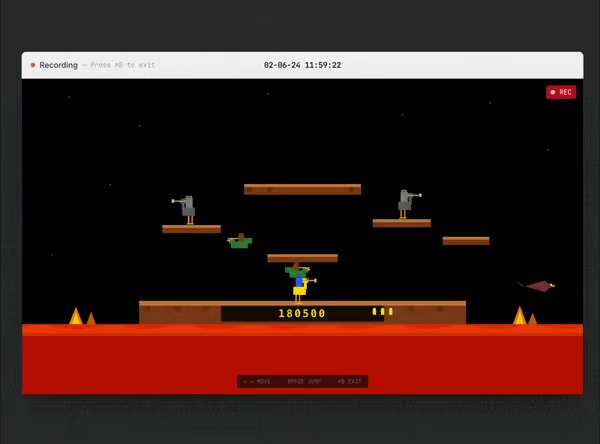
I've been testing how far this goes on my own time too. With two prompts and one screenshot, I built a fully playable arcade game, complete with a clip-scrubbing interface to replay the last two minutes of gameplay. You can't do that in Figma. You can't make an actual video game and have a user test the game itself and the engine interface at the same time. It's mind-blowing how good these tools have gotten in such little time.
Jing: Do you worry that AI is making designers less valued?
Derick: Some designers feel AI will shrink what people will pay designers to do. I think it's more specific than that.
Historically, product design especially had been tilting toward UX thinking — flows, systems, behavior — and visual craft was sometimes secondary. Now that AI can scaffold functional UI from a prompt, craft is exactly what the output is missing. What I've seen from most AI-generated work: it looks okay, it works, it's fun to play with. But there's a lot to be desired from a professional standpoint.
The gap is visual judgment: knowing when breaking a rule makes something better. LLMs can combine principles, but they don't know when violating a pattern creates something unexpected and right. That's not a workflow problem. It's a taste problem. And taste takes longer to build than any tool skill.
Where does taste actually come from? For me, it's everywhere — not just user interfaces.
Jing: What does that look like for you outside of work?
Derick: Everything I do outside of work it finds its way back in. I go to art museums and try to sit with why a specific piece stops me. I think about my apartment the same way. How you decorate your space, what music you're into, what art moves you — those things define your sensibility, and that finds its way into every design decision you make. Which type you reach for. How much space you give a component. When you follow a convention and when you don't.
My favorite example is a scene from The Devil Wears Prada (I've seen it over ten times) where Miranda Priestly explains that the plain blue sweater Anne Hathaway is wearing traces back to a deliberate choice at a fashion house, several seasons prior, trickled down until it looked ordinary. I think about that constantly. Everything gets remixed. What's the origin of this? What's the version before this version? Taste isn't built on a screen. It's built everywhere else, and then brought to the screen.

Jing: For designers who haven't made the jump yet — where do you start?
Derick: Try the tools. See what works for you. Figure out the why behind them, not just the how. We can't be resistant to change. If you want to stay relevant, learn new tools and adapt your process. It's really that simple.
The reason it's worth your time to experiment isn't because the industry says so or your company is pushing AI OKRs. It's because some of these tools genuinely make our work better. Try the tools, keep what works for you, that's the only bar that matters.
I’ve been reflecting on what Derick said about visual craft. AI doesn't just expose visual decisions earlier, it exposes everything. Bad UX used to hide behind static screens or single-flow prototypes that required everyone to imagine the hard parts. Nobody knew whether it would really work until the thing was built, and by then they had to ship it, even if it was confusing.
That's what I think "designing with AI" really means for the future. We're becoming full-stack designers — not in the old sense of juggling tools and processes, but in the new sense of being accountable for the full stack of experience from the very beginning. The prototype behaves like the real product from day one, which means everything that affects an experience — visual, UX, or even product positioning — is on us as designers to deliver the whole package together.
We're building out Scribe's design team. If this sounds like how you want to work, we'd love to talk.

Ready to try Scribe?


Copyright © 2026 Colony Labs, Inc. dba Scribe. All rights reserved.